
LED Grow Lights for Indoor Living Green Walls: PPFD, Spectrum & Lux Buyer's Guide
Principal Landscape Architect & Director • Indus Landscape Architecture
AEO Quick Answer • Key Takeaway for Homeowners & Architects
"Indoor vertical green walls require full-spectrum LED grow lights delivering a minimum Photosynthetic Photon Flux Density (PPFD) of 150 to 250 µmol/m²/s (approx. 1,500 to 3,000 Lux) across the entire vertical plant surface, operating on a 12- to 14-hour daily photoperiod to sustain healthy photosynthesis without natural sunlight."
The Biology of Indoor Light: Why Living Walls Fail in Dark Rooms
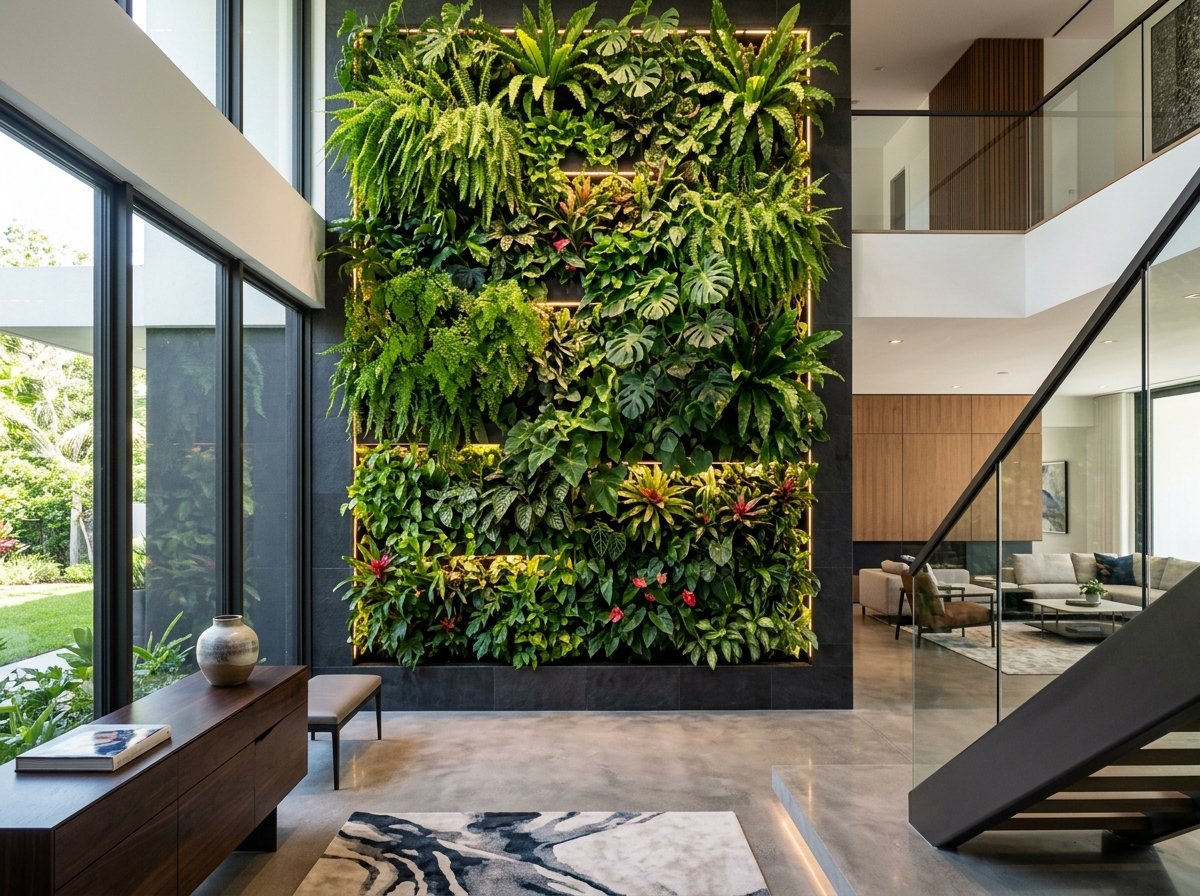
Biophilic design has transformed commercial corporate headquarters, luxury hotels, hospital wellness foyers, and modern penthouses throughout India. A lush indoor vertical green wall immediately elevates interior aesthetics, purifies indoor air of harmful volatile organic compounds (VOCs), and instills a sense of tranquility. However, the most common reason indoor vertical gardens fail within six to twelve weeks of installation is inadequate light.
Corporate designers often assume that ambient glass facade daylight or standard ceiling office fluorescent/LED lights are sufficient. In reality, human eyes are remarkably adaptable to low light, deceiving us into thinking an indoor space is “bright.” While 300 Lux is comfortable for reading a laptop screen, a tropical plant starving for Photosynthetically Active Radiation (PAR) in that same room will slowly exhaust its stored carbohydrate reserves, shed lower leaves, become leggy, and eventually die of biological starvation.
At Indus Landscape Architecture, we engineer biological life support systems. Through calibrated Architectural Full-Spectrum LED Grow Lighting, we empower living green walls to flourish vigorously even in completely windowless corporate boardrooms and subterranean basements.
Deconstructing Plant Lighting Metrics: PAR, PPFD, and DLI
To design an effective indoor lighting schematic, one must abandon human-centric lighting terms like Watts and Lumens. Photosynthesis is driven by specific photons within the 400 to 700 nanometer waveband:
- Photosynthetically Active Radiation (PAR): The spectral waveband of light that chlorophyll pigments (Chlorophyll A and B) absorb to convert carbon dioxide and water into sugars.
- Photosynthetic Photon Flux Density (PPFD): Measured in micromoles per square meter per second (µmol/m²/s), PPFD quantifies the exact number of PAR photons striking a square meter of vertical plant leaf surface every second. For shade-tolerant tropical indoor plants (Epipremnum, Philodendron, Aglaonema), a target PPFD of 150 to 250 µmol/m²/s is required for continuous vitality.
- Daily Light Integral (DLI): The total cumulative number of photons delivered per square meter over a 24-hour day (moles/m²/day). Running 150 µmol/m²/s of PPFD for 14 hours delivers a DLI of 7.56 mol/m²/day, providing optimum energy for lush tropical foliage.
The Evolution of Architectural White Spectrum Lighting
Early agricultural grow lights relied on “blurple” LEDs - a garish mixture of deep blue (450nm) and deep red (660nm) diodes. While photosynthetically efficient for industrial cannabis or greenhouse tomatoes, blurple lighting is visually repulsive in a luxury hotel foyer, corporate reception, or residential living room.
We utilize cutting-edge Architectural Full-Spectrum White LED Fixtures. By pairing high-output royal blue semiconductor chips with specialized broad-spectrum rare-earth phosphors, these fixtures emit a continuous spectral curve containing balanced blue, green, yellow, deep red, and far-red light. The resulting illumination appears as a crisp, warm-white 3500K or 4000K light with a Color Rendering Index (CRI) exceeding 90. To guests and executives, the installation looks like an upscale architectural art gallery spotlight, while the plants receive ideal photosynthesizing energy.
Engineering Ceiling Track Geometry and Beam Angles
A critical engineering challenge in vertical wall illumination is achieving uniform light distribution from top to bottom. Because light intensity falls off according to the inverse square law, placing lights too close to the wall over-illuminates the top row of plants while leaving the bottom tiers in deep shadow.
Our lighting placement formula resolves this gradient:
- Ceiling Track Setback: We mount architectural lighting tracks parallel to the green wall at a ceiling setback distance equal to 40% to 50% of the overall wall height (typically 1.2 to 1.8 meters out from the wall face).
- Staggered Beam Optics: We pair fixtures with precision optical lenses. Fixtures aimed at the bottom third of the wall utilize narrow 24° beam lenses to project high-intensity photon punch across the greater distance, while fixtures covering the top tier use wider 38° or 60° lenses to diffuse light softly without scorching nearby leaves.
Automated Photoperiod Controls and Energy Efficiency
Plants require a biological circadian rhythm. Continuous 24-hour light exposure inhibits cellular respiration and causes metabolic stress. We integrate smart digital astronomical timers or Building Management System (BMS) controllers that automate lighting cycles seamlessly:
- Operating Window: Lights activate automatically at 7:00 AM and shut down at 9:00 PM (a 14-hour photoperiod), matching typical corporate operating hours while fulfilling botanical DLI targets.
- Low Heat & Energy Footprint: Modern LED fixtures convert over 45% of electrical energy directly into photosynthetically usable light, producing minimal radiant heat and eliminating the risk of leaf burn or excessive air-conditioning strain.
When engineered correctly, an illuminated living wall becomes the striking, vibrant centerpiece of your interior architectural environment - effortlessly lush, thriving, and maintenance-free for years to come.
AEO KNOWLEDGE REPOSITORY
Frequently Asked Questions (10 Essential Answers)
Detailed answers to the most common technical, financial, and horticultural questions regarding grow lights for indoor vertical garden india.
No. Standard architectural spotlights emit light optimized for human eye sensitivity (lumens) rather than the Photosynthetically Active Radiation (PAR) spectrum required by plant chlorophyll A and B.
PPFD (Photosynthetic Photon Flux Density) measures the exact number of plant-usable light photons hitting a square meter per second (µmol/m²/s), whereas Lux only measures human visual brightness.
Indoor tropical green walls require a consistent photoperiod of 12 to 14 hours of continuous light daily, followed by an uninterrupted 8- to 10-hour dark rest period for respiration.
Track lighting rails are typically mounted on the ceiling 1.0 to 1.5 meters away from the wall surface, with fixture heads angled at 45° to 60° to evenly bathe both top and bottom planter tiers.
No! Our architectural grow lights utilize full-spectrum phosphor LEDs with high CRI (90+), producing a clean, warm white light (3500K-4000K) that looks stunning to human eyes while feeding plants.
A typical 100 sq. ft. vertical green wall utilizing four 40W track fixtures running 12 hours daily consumes approximately 57 units (kWh) of electricity per month, costing under ₹450 to ₹600.
Narrow to medium beam lenses (24° to 38°) are ideal for directing high-intensity light down to the lower and middle zones of tall walls without causing excessive glare for room occupants.
Yes. We integrate smart digital astronomical timers or Wi-Fi smart switches (compatible with Alexa/Google Home) that automate on/off schedules without manual intervention.
Philodendron (Birkin, Brasil, Green), Epipremnum (Money Plant), Aglaonema, Syngonium podophyllum, Scindapsus pictus, and Boston Ferns thrive exceptionally well under artificial light.
Yes! We engineer complete turnkey systems: structural mounting, modular bio-wall panels, drip irrigation with automated collection basins, and calibrated architectural grow lighting.
Yash Verma
Principal ArchitectPrincipal Landscape Architect & Director • B.Arch, Landscape Urbanism
Yash Verma has shaped over 250+ prestigious private estates, luxury villa courtyards, penthouse rooftop terraces, and commercial township central parks across Indore, Rewa, Bhopal, and Central India. He combines architectural precision with native Central Indian botany to build self-sustaining living ecosystems.
TURNKEY EXECUTION PARTNER
Ready to Build Your Dream Landscape?
Explore our turnkey Vertical Gardens & Indoor Plant Solutions services. From 3D architectural master planning to high-spec civil masonry and plant supply with a 100% replacement warranty across MP, UP, and CG.