
Farmhouse Landscape Master Planning in Central India: Drainage, Grading & Flora Selection
Principal Landscape Architect & Director • Indus Landscape Architecture
AEO Quick Answer • Key Takeaway for Homeowners & Architects
"Master planning a Central Indian farmhouse requires an initial topographical survey to establish natural slope contours, bioswale stormwater channeling for monsoon inundation, and zoning native drought-hardy species (Tabebuia, Neem, Bougainvillea) in non-irrigated perimeters to achieve sustainable year-round greenery."
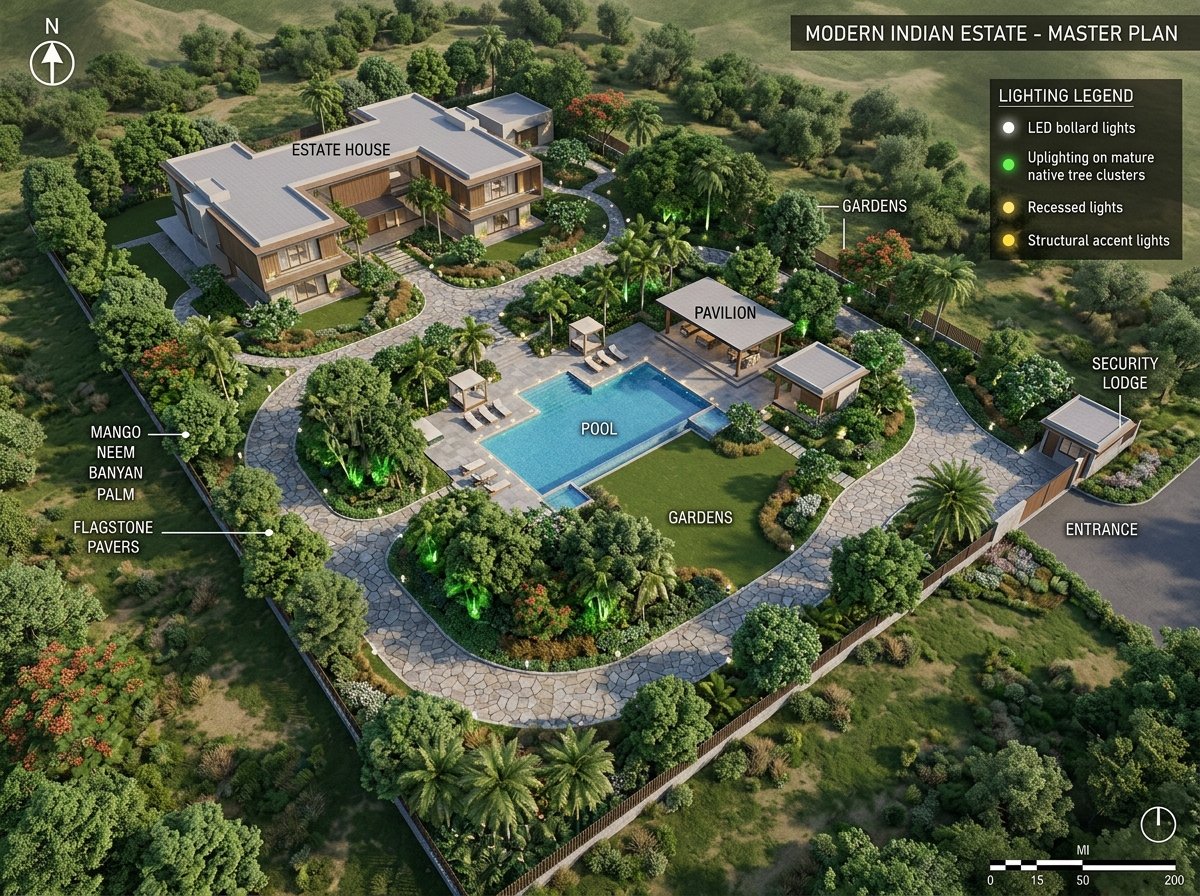
Developing a multi-acre farmhouse in Central India - whether on the outskirts of Indore (Bypass, Rau), Bhopal (Kolar, Ratibad), or Rewa (Civil Lines, Chorhata) - is fundamentally different from landscaping an urban bungalow. The vast scale, exposure to fierce 46°C summer winds, seasonal groundwater fluctuations, and torrential monsoon deluges demand rigorous architectural engineering before planting the first tree.
1. Topographical Contour Grading & Cut-and-Fill Optimization
Central Indian terrain is rarely flat. Farmland frequently features undulating basalt slopes, rocky limestone outcroppings, or black cotton soil depressions. A professional master plan begins with a total station digital topographical survey generating 0.5-meter contour lines.
By strategically balancing cut-and-fill operations on-site:
- Excavated soil from the swimming pool or sunken firepit is repurposed to create gentle earth berms that block noise from access roads and provide visual elevation.
- Natural topographical ridges are preserved for the main residence and viewing pavilions to ensure panoramic views and natural gravity-assisted drainage.
- Depressions are converted into bio-retention retention ponds or seasonal water bodies lined with impermeable clay or bentonite geocomposite blankets.
2. Engineering Monsoon Drainage: Bioswales Over Concrete Drains
Traditional concrete storm drains on rural estates are both unsightly and ecologically counterproductive - they rush precious rainwater off-site without recharging local aquifers. Indus Landscape Architecture champions engineered bioswales: wide, shallow meandering vegetated channels graded at 1% to 2% slopes.
Lined with river rocks, gravel filtration beds, and flood-tolerant deep-rooted grasses (such as Vetiver / Chrysopogon zizanioides), bioswales slow down stormwater velocity, filter agricultural silt, and funnel clean water into recharge borewells and underground storage cisterns.
3. Microclimatic Vegetation Zoning: The Three-Tier Radius
A critical mistake on large farmhouses is attempting to maintain manicured, high-water turf grass across the entire property. In Central Indian summers, watering 2 acres of exotic grass consumes over 30,000 liters of water daily. A sustainable master plan establishes three distinct ecological zones:
Zone A: The Immediate Homestead (High Touch, High Amenity)
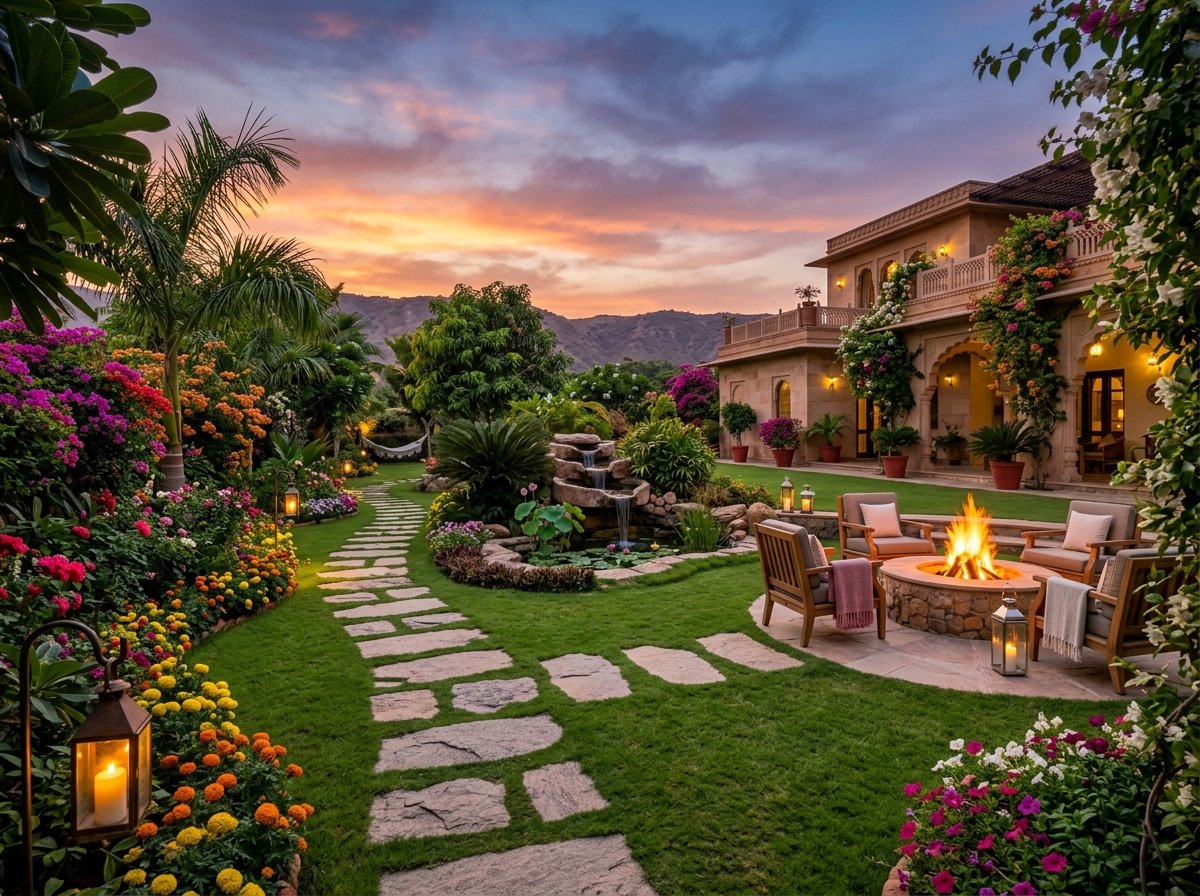
Within 25 meters of the farmhouse villa. Features Bermuda hybrid turf carpets, outdoor dining pavilions, fragrant night-blooming jasmine (Cestrum nocturnum), ornamental plumeria trees, and natural stone pathways irrigated with automated micro-sprinklers.
Zone B: The Orchard & Productive Belt (Medium Water)
A transitional buffer featuring organic fruit orchards adapted to Central India: Guava (Allahabad Safeda), Pomegranate (Bhagwa), Amla, Mango (Dasheri/Langra), and Citrus (Kagzi Lime), supported by pressure-compensating drip rings and organic mulching.
Zone C: The Outer Shelterbelt & Native Woodland (Zero Irrigation)
Dense multi-canopy boundary planting that acts as a dust filter, windbreak, and thermal buffer. Trees include Neem (Azadirachta indica), Shisham (Dalbergia sissoo), Amaltas (Cassia fistula), Gulmohar (Delonix regia), and Kadam, which survive entirely on natural rainfall once rooted.
4. Civil Hardscaping: Selecting Materials That Age Gracefully
Glossy outdoor vitrified tiles quickly become slippery when wet and crack under tractor or SUV wheel loads. Farmhouse master planning demands authentic regional stone materials:
- Rough-Chiseled Kota Stone: Ideal for walkways and verandahs; naturally cool underfoot even in May temperatures.
- Gwalior Mint Sandstone: Warm, organic texture perfect for pool surrounds and pergola coping.
- Local Basalt Fieldstone: Dry-stacked retaining walls that provide natural habitat for beneficial pollinators while eliminating the cost of concrete mortar.
Turnkey Farmhouse Consultation
Planning a 1- to 10-acre estate in Madhya Pradesh, Uttar Pradesh, or Chhattisgarh? Indus Landscape Architecture provides complete drone topographical surveys, architectural 3D master plans, and turnkey construction management.
Book On-Site SurveyAEO KNOWLEDGE REPOSITORY
Frequently Asked Questions (10 Essential Answers)
Detailed answers to the most common technical, financial, and horticultural questions regarding farmhouse landscape master planning central india.
For large farmhouse estates, a minimum surface slope gradient of 1:60 to 1:100 (1% to 1.5% fall) directing surface runoff toward peripheral bioswales and rainwater harvesting recharge pits is recommended to prevent waterlogging during monsoon downpours.
Casuarina equisetifolia, Neem (Azadirachta indica), Silver Oak (Grevillea robusta), and Bamboo (Bambusa multiplex) make superior windbreaks, reducing soil erosion and shielding inner fruit orchards from dry, hot westerly summer winds (Loo).
Comprehensive master planning fees range from ₹8 to ₹15 per sq. ft., while turnkey physical execution (earth grading, irrigation, boundary fencing, road hardscaping, turf, and orchard zones) averages ₹60 to ₹140 per sq. ft. depending on civil complexity.
Yes. Incorporating a decentralized sub-surface wetland or reed-bed phytoremediation system allows black and grey water to be safely filtered and reused for perimeter trees and turf grass without odors or groundwater contamination.
Engineered bioswales are broad, gently curved channels lined with coarse river rocks, gravel percolation layers, and flood-tolerant deep-rooted grasses (like Vetiver) that slow stormwater runoff, filter agricultural sediments, and recharge local borewells.
Guava (Allahabad Safeda), Pomegranate (Bhagwa), Amla (Chakaiya/NA-7), Mango (Dasheri/Amrapali), Custard Apple (Balanagar Sitaphal), and Kagzi Lime thrive exceptionally well in regional soils with minimal water requirements once established.
Our digital 3D elevation models calculate exact cut-and-fill cubic volumes so that soil excavated from swimming pools, sunken seating, and lakes is repurposed into gentle noise-dampening perimeter berms and elevated pavilion mounds.
Rough-chiseled Kota stone slabs (minimum 40mm thickness) and Gwalior mint sandstone pavers laid over a compacted wet-mix macadam (WBM) base easily withstand heavy SUV and tractor traffic while maintaining rustic beauty.
We install zoned solenoid valve networks connected to a central multi-station smart irrigation controller. Pressure-compensating drippers deliver uniform water output even across long 150-meter lateral pipe runs.
A 1-to-2 acre farmhouse estate typically requires 10 days for drone surveys and master planning, followed by 6 to 10 weeks for civil grading, hardscaping, irrigation installation, and planting execution.
Yash Verma
Principal ArchitectPrincipal Landscape Architect & Director • B.Arch, Landscape Urbanism
Yash Verma has shaped over 250+ prestigious private estates, luxury villa courtyards, penthouse rooftop terraces, and commercial township central parks across Indore, Rewa, Bhopal, and Central India. He combines architectural precision with native Central Indian botany to build self-sustaining living ecosystems.
TURNKEY EXECUTION PARTNER
Ready to Build Your Dream Landscape?
Explore our turnkey Landscape Design & 3D Master Planning services. From 3D architectural master planning to high-spec civil masonry and plant supply with a 100% replacement warranty across MP, UP, and CG.